Elementa
⚛︎ ELEMENTA ⚛︎ — the elements
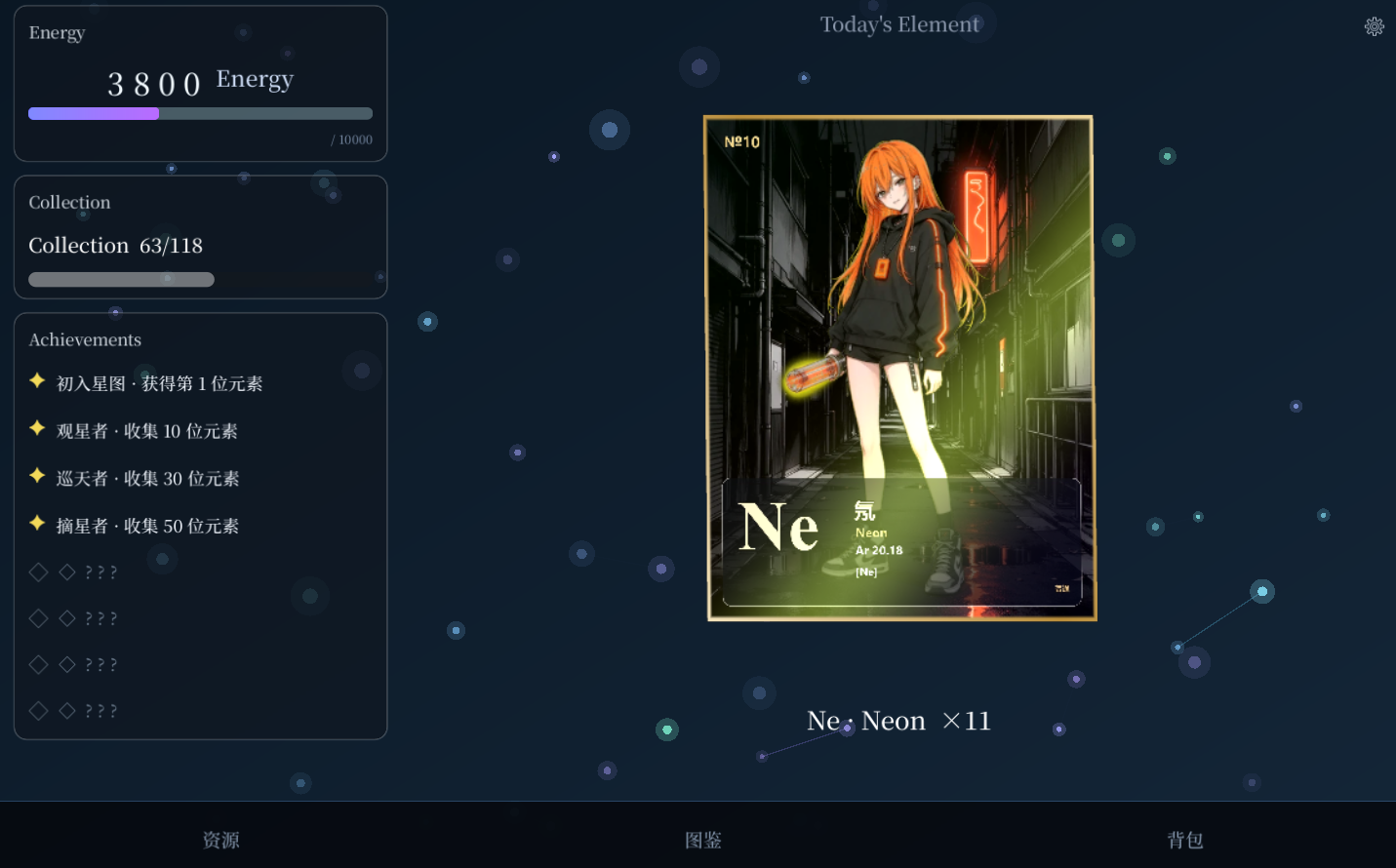
One hundred and eighteen chemical elements, reimagined as one hundred and eighteen girls. Summon them. Collect them. Fuse them. Learn why they are the way they are.
A collection game about the periodic table — where every character's hair colour, her prop, her posture and her whole personality are derived from the real chemistry of the element she embodies.
▶ Play our beta: elementa-official.itch.io/elementa
▶ Or try the beta demo: elementa-online.pages.dev (a beta public build — mechanics are in place, content is still being finished)

What it is
Elementa began as a single-file browser game and has been rebuilt as a full title in Godot 4.7. It sits somewhere between a science archive and a character collection: a quiet, starfield-backed UI in which the periodic table quietly turns out to be a cast.
The premise is simple. If you take the periodic table seriously, it already reads like a set of personalities — and the game simply refuses to cheat.
| Element | Why she is the way she is |
|---|---|
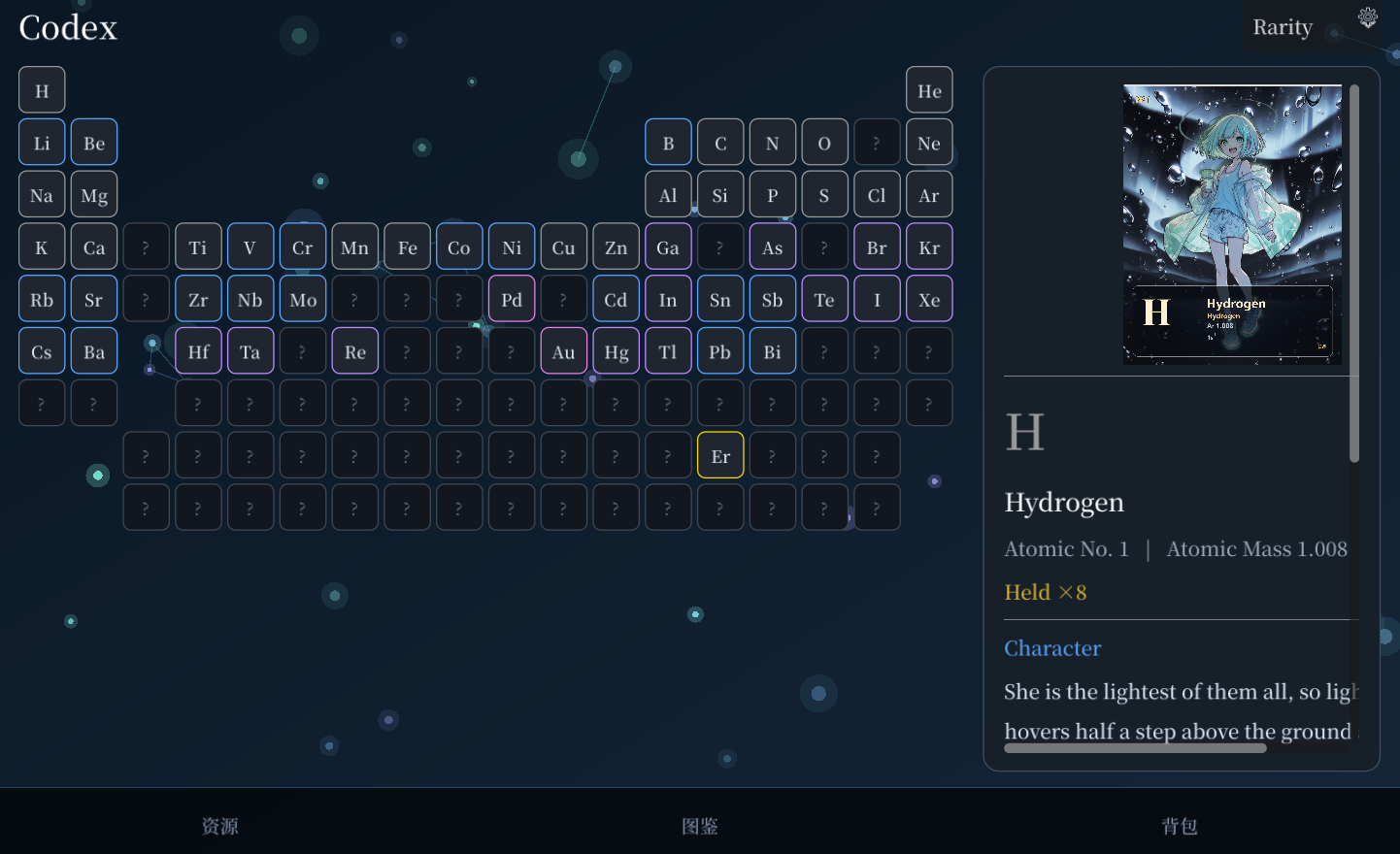
| H · Hydrogen | The lightest of all, so she hovers half a step above the ground and slips out of any hand. Born first, still holds ~75% of the mass of the universe. |
| Fe · Iron | Stands in the draught of an abandoned steel mill holding a red-hot pair of tongs — the backbone of industry, and of your own haemoglobin. |
| Au · Gold | The most chemically inert and the least inclined to ever lose its shine; money for six thousand years, and the most malleable metal there is. |
| Ar · Argon | So unreactive that she carries a light bulb that has never once lit — the reliable shielding gas at the welding seam. |
| U · Uranium | Guarding the one thing that must never be opened. Reactor fuel, and a geologist's clock for dating rock. |
Each card carries a short in-character biography, written so the science lives inside the story rather than being listed as a datasheet. The facts are there. She just tells them herself.
And then there is Ev — Eveningglowium, atomic number 0. A hidden meta element that is not on the table, not in the draw pool, and not listed in the Codex until you find her. She is a rainbow-chrome metal named after the game's author, and she has strong opinions about being the best element in the world. There is exactly one way to reach her, and it is not the one you would guess.
How it plays
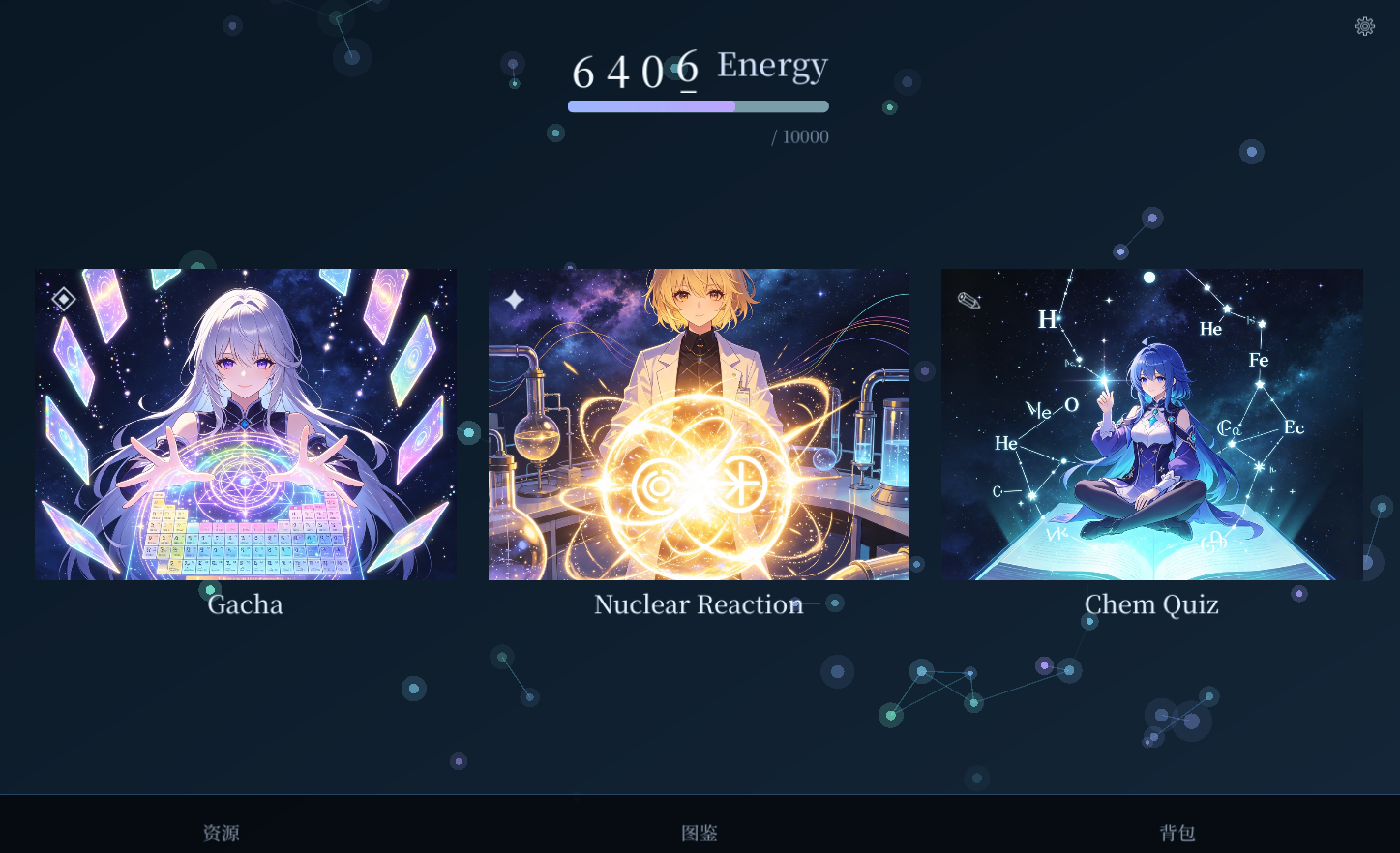
⚡ Energy — the one currency Energy regenerates on its own at +1/s, up to a ceiling of 10,000. Everything costs energy: draws, fusion. It is earned, not bought. Complete a whole group of the periodic table in your collection and the regeneration rate permanently rises — +1/s per group, and +5/s for the group that actually contains the lanthanides and actinides. A complete collection is a faster engine.
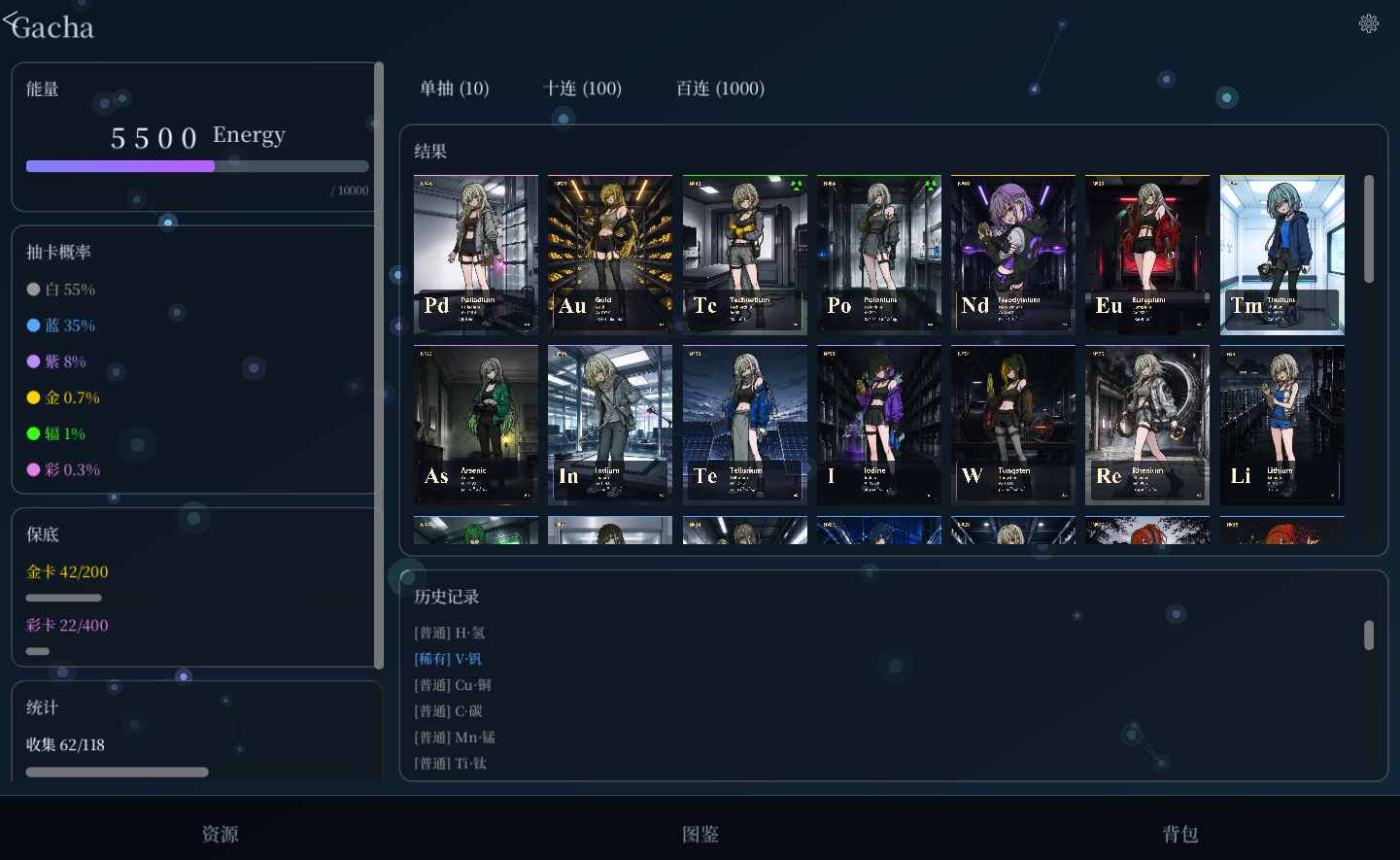
◈ Summoning Three batch sizes: single (10), ×10 (100) and ×100 (1,000). Seven tiers, from ★ Common through Rare, Epic, Legendary, Radioactive and Transuranic, up to the rainbow ★ Rainbow — with published rates and a live pity counter that marks your place in the bar. Legendary is guaranteed within 200 draws; Rainbow within 400. Every pull records badges for a new element and for a pity hit, so a long dry streak is legible instead of invisible.
✦ Fusion — transmutation by hand
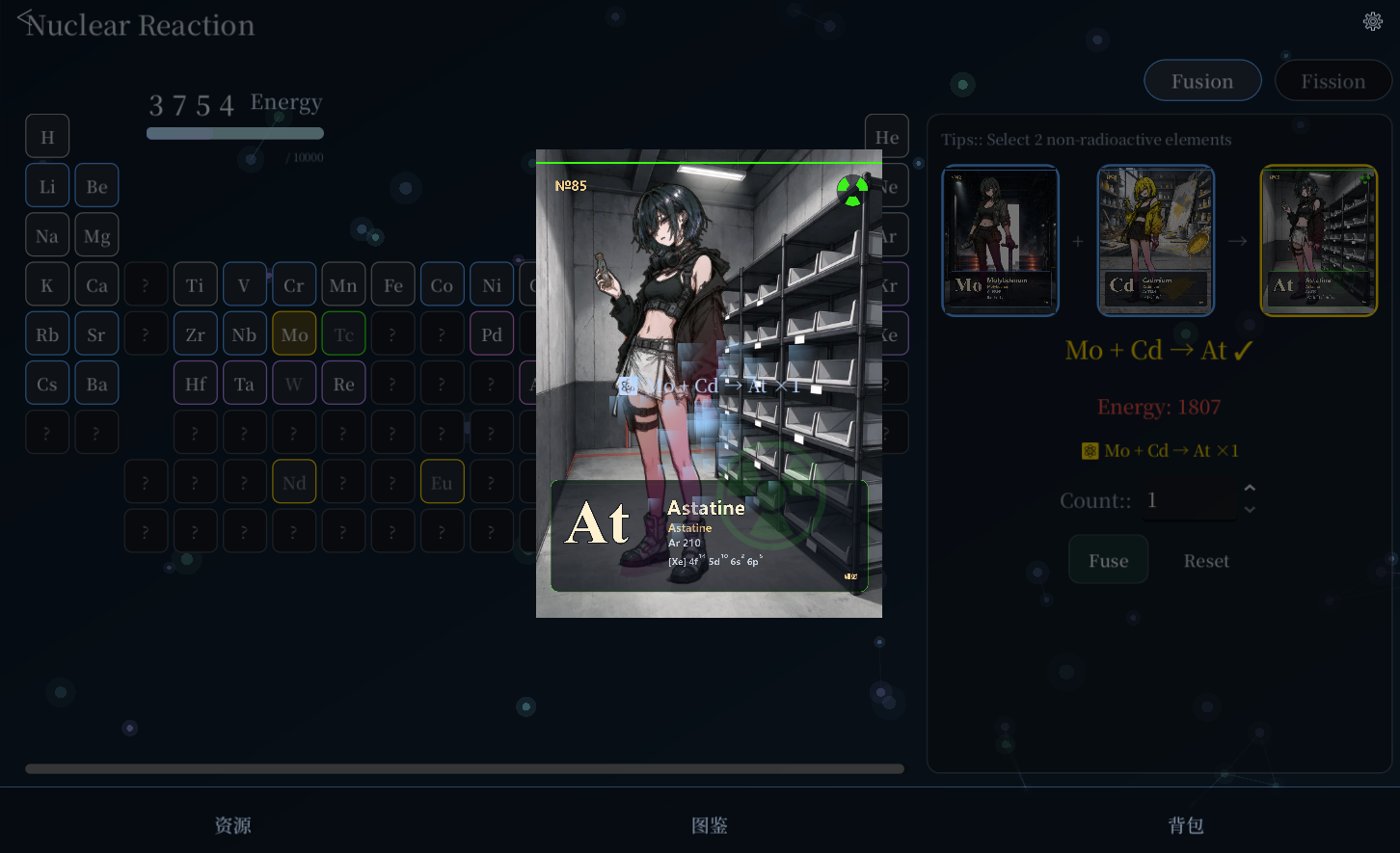
Pick any two elements you hold and fuse them. Products follow the real fusion path, so
H + He → Li does what physics says it should. The energy cost is computed from nuclear binding
energy via a semi-empirical mass formula — fusing light nuclei releases energy, fusing heavy ones
consumes it — including the special case where He + Be → C pays you back. Batch up to 9 at a time.
You are not picking from a menu. You are running a reaction.
☢ Fission — the other direction Radioactive and transuranic elements with two or more copies can be split into a pair of lighter products, with a small energy rebate scaled to atomic number. It is the reliable way to turn a stock of heavy cards back into material you can actually use.
⚛ The Codex — a periodic table that is also a gallery The full table, in three colouring modes: Rarity, Category (non-metal, halogen, noble gas, alkali metal, alkaline earth, p-block, transition, lanthanide, actinide) and Natural — the element's real-world colour. Collect to reveal. Undiscovered entries stay hidden until you hold them.
⟳ A card you can actually turn over Every character can be opened in a viewer and rotated 360° by dragging, zoomed with the wheel. Turn her around and the back is there — tinted by rarity, foil-stamped, with the ⚛ mark. Click to close.
✎ Chemistry quiz — 201 questions, four languages Answer correctly for 200 energy, plus a +50 bonus per consecutive correct answer for as long as your streak holds; a wrong answer costs 100. Unlimited play — this is the honest way to fund a fusion habit, and it is much more generous than idling.
☑ Task list — seven objectives Structured goals drawn from the shape of the table itself: alkali and alkaline earth metals, non-metals, p-block metals, noble metals, d- and ds-block metals, the entire f-block, and every radioactive element. Rewards scale from 300 to 5,000 energy, and the last ones are genuinely hard. Clearing the f-block is a project, not an afternoon.
💾 Progress that survives Autosave, and a portable save code you can copy out and paste into another device. Languages: 中文 · English · 日本語 · Français — including the character writing itself, not just the menus.
The cards
The art is not a flat image. Each character is a layered composite — background, subject, ink
linework and nameplate — rendered through a SubViewport with an orthographic camera, so the layers
separate with real parallax as the card turns. On top of that sits a holographic foil that drifts
with the viewing angle and catches a spectral highlight as it sweeps past.
The nameplate exists as a separate baked layer for each of the four languages, so switching language swaps one layer instead of rebuilding the card — and a missing language layer falls back gracefully rather than breaking the card.
The result is a card that behaves like an object: pick it up, spin it, look at the back.
Under the hood
- Engine — Godot 4.7, GDScript, 2D pipeline with 3D card rendering
- Content — 119 characters (118 elements + one hidden), 201 quiz questions, 4 languages
- Presentation — procedural starfield, layered card compositing via custom shaders, 13 music tracks
- Platforms — web first, then desktop and mobile; the web build runs multithreaded
Credits
| Original developer | EveningGlow_ — original concept, character design, artwork, writing, the original web release and Godot remake |
| Co-developer | Yishengdaxiaonengjihui — Godot remake |
The original game, its characters and its artwork are the work of EveningGlow_. This Godot version is a remake built that uses the original assets.
Code is released under the MIT licence. Artwork and writing remain all rights reserved — please credit and link if you share them, and do not redistribute them commercially.
Get in touch
- Feedback & bug reports — eveningglow838@gmail.com
- Community Discord — Elementa Community
Found the game reuploaded somewhere it should not be, or something used without permission? Email the address above, and thank you.
© 2026 EveningGlow. All rights reserved.
</article>